Friday, June 17, 2011

Destiny Binds: Character Interview

Sometimes strange circumstances bring you into contact with people you would otherwise never have met.  One of those circumstances led me to Tammy Blackwell.  At that time, Tammy was working on a manuscript for a YA fantasy story.  I offered to read her story and provide some feedback.  When I received the computer file, I opened up the document and started reading.  Several hours later, I had finished the manuscript and was emailing her a message that basically went something like this - "there better be more or else".  Destiny Binds is the finished version of that early manuscript that I read.  I will be posting a review of tomorrow with a giveaway.

As a teaser to get readers interested in Destiny Binds, Tammy answered a bunch of questions that I posed to Scout (the main character) and her brother Jase.  Hope you enjoy meeting Scout and Jase and get a taste of Tammy's humor.     

What's the worst thing about sharing a bathroom?

Scout: Wet towels that never seem to make it to the rack. A toilet seat that is never down. Basketball uniforms that get wadded up and thrown in the corner until they’re able to walk downstairs to the washing machine all by themselves.

Jase: Squeezable Lip Smackers.

Scout: Seriously? That was like five years ago.

Jase: And I spent four months never knowing when or where I would discover glittery, cherry flavored blobs on my person.

What are 5 things you would expect to find in your sibling’s backpack?

Jase: The Big Boring Book of Math; The Big Boring Book of English; The Big Boring Book of History; The Backwards Book of Weird Japanese Comics; and a pack of gum

Scout: Sports Illustrated; homework he should have turned in three weeks ago; a collection of McDonald’s receipts; an entire bag’s worth of potato chip crumbs; and the iPod Angel can’t find anywhere

Jase: I do not have Angel’s iPod

Scout: *raises eyebrows*

Jase: You’re not going to tell her, are you?

What is on your iPod/MP3 players?

Scout: I’ve been listening to a lot of Sea Wolf and Josh Ritter lately

Jase: What she means is, “I’ve been listening to whiny, folky crap that makes you want to slit your wrists.”

Scout: So says the boy who thinks Jay-Z qualifies as music.

Jase: Jay-Z does qualify as music. Just ask the Grammy’s.

Scout: You know who else wins Grammy’s? Taylor Swift.

Jase: Point taken.

What is your idea of the perfect date?

Jase: Front row tickets to a Lakers game and some In-and-Out burgers.

Scout: How on earth do you manage to talk girls into dating you? Does the word “romance” mean anything to you?

Jase: My date involves a trip to LA. That’s classy. But I suppose it doesn’t live up to the romance of all those nights you sat at Dairy Queen listening to Dalton Riley ramble on about he was going to go to Harvard because he was the smartest man to ever live.

Scout: I hate you.

Who is your favorite fictional character and if you could spend an afternoon with them what would you do?

Scout: That’s hard. Atticus Finch would be cool, but I don’t know what we would really do together. I mean, I don’t really have any desire to be involved in a racially charged trial and my dad is pretty awesome, so I don’t really need any of that fatherly stuff. Would it be too horribly trite to say that I would want to hang out with Harry Potter at Hogwarts? Because, seriously, that would be awesome.

Jase: I want a one-on-one match with Michael Jordan.

Scout: Michael Jordan is a real person.

Jase: Yeah. So?

Scout: So he’s not a fictional character. Pick a fictional character.

Jase: Fine. I want to hang out with Harry Potter, too. But not at the school. I want to go to that store Fred and George opened. That looked really cool in the movie.

Who was your favorite TV cartoon character as a kid?

Jase: Scooby Doo. He was the coolest dog ever.

Scout: A tie between Buttercup and Mojo Jojo from The Powerpuff Girls.

Jase: Mojo Jojo? Why do you always like the bad guys?

Scout: They’re not bad. They’re just misunderstood.

If you can have any kind of supernatural power/ability what would it be?

Scout: I want to be Batman. I know that’s not really a supernatural power, but those always seem so silly. I mean, immortals who are allergic to garlic or sparkle in the sun? Seriously?

Jase: Vampires are stupid, but people who can turn into animals? That’s cool. I would be one of those.

Last question, if you found your sibling’s diary, would you read it?

Scout: Jase doesn’t keep a diary.

Jase: But if I did...?

Scout: Honestly? I would probably read a few pages before the guilt made me stop. Unless it’s an account of your dating escapades. Then I would only make it a couple of sentences before the nausea hit. Would you read my diary?

Jase: Been there, done that.

Scout: You have not.

Jase: “Today I almost tripped Ashley Johnson in the hallway. I didn’t, of course, but I seriously thought about it. I imagined it all in my head. Her toppling over and bursting those stupid, fake boobs...”

Scout: Give me one good reason not to kill you.

Jase: Because I’m your brother and you love me.


Thanks to Miss Tammy for the character interview.  Tammy Blackwell is the Young Adult Services Coordinator for a public library system in Kentucky. When she's not reading, writing, or cataloging books, she's sleeping.  She is the author of the YA Novel Destiny Binds

Monday, June 6, 2011

Marvelous Middle Grade Monday - How They Croaked: The Awful Ends Of The Awfully Famous

Author:  Georgia Bragg
Illustrator: Kevin O'Malley
Publisher: Bloomsbury Walker (March 15, 2011)
Audience: Grades 5 to 8
Source: Copy for Review
Non-Fiction * Middle Grade * History

Description from GoodReads:
Over the course of history men and women have lived and died. In fact, getting sick and dying can be a big, ugly mess-especially before the modern medical care that we all enjoy today. How They Croaked relays all the gory details of how nineteen world figures gave up the ghost. For example:

It is believed that Henry VIII's remains exploded within his coffin while lying in state.
Doctors "treated" George Washington by draining almost 80 ounces of blood before he finally kicked the bucket.
Right before Beethoven wrote his last notes, doctors drilled a hole in his stomach without any pain medication.
Readers will be interested well past the final curtain, and feel lucky to live in a world with painkillers, X-rays, soap, and 911.


From the title of the book to the cover of the book to the actual content of the book, Bragg has a winner on her hands.  It is fun finding non-fiction that is written in an interesting, easily readable manner.  Each chapter centers on one of nineteen different famous people (many whom are related or connected in some manner) and is followed by two pages of historical facts related to that particular famous person or his/her manner of death. 

How They Croaked is fun in that gross sort of way.  The reader is treated to many of the gory details of how crude medical treatments of the time likely contributed more to the deaths of these famous individuals than possibly the actual diseases.  In a few cases, the causes of their deaths were related to the careers they were consumed by.  For example, I never really thought about how Marie Curie's research would contribute to her death which was caused basically by prolonged exposure to radiation.  

Bragg doesn't hold back with her descriptions but at the same time the tidbits about the lives, loves, relationships and quirky habits of each of these historical figures are woven into each chapter.  Never, in some ways, has history been so fun.  Catchy chapter titles, modern vernacular, and just the right amount of witty humor make each chapter a quick read.  The book can be read in order (which is also chronologically ordered) or can be read by picking and choosing your favorites.  I did a little of both.  However, I will say, the connections between some of the individuals are more evident when reading it in order.  Also, How They Croaked can be read in one sitting or a couple of chapters at a time, but once I got started I had trouble putting it down.

Parents, teachers, librarians looking to entice that elusive male reader may want to suggest that they give this one a read.  And though the book may be listed as being for 5th to 8th graders, I would suggest that this is one book that will be just as likely read by a 5th grader as an adult.  How They Croaked is definitely a book to add to a school library.  My guess is once it is book talked, it won't stay on the shelves for long. 

For more information about Georgia Bragg, check out her website: http://georgiabragg.com/
Here is the link to an interview that NPR did on How , click here to check it out.

* Marvelous Middle Grade Mondays were started by Shannon over at Ramblings of a Wannabe Scribe. You can check out her Marvelous Middle Grade Monday choice and Giveaway Post here.

Sunday, June 5, 2011

Interview with Cheryl Rainfield, Author of Scars

About a month ago, Cheryl Rainfield agreed to do an interview for Kid Lit Frenzy,  In light of the Wall Street Journal Article, we decided that the interview needed to be posted today.  Thanks Cheryl for such a quick but thoughtful responses to my questions. 

What advice/suggestions would you give a teen who has a friend that is engaging in self-harm behavior? I know as a teen I wasn't certain what to do when I discovered that a friend was cutting. I stood by her but wish I could have done more.

I think the most important thing is to respond with compassion, and to let your friend know that they don't deserve to be hurt, even by themselves. It might not sound like a lot, but a compassionate, caring response can really go in there, and it helps encourage healing, instead of increasing the shame or blame. It can also help to ask them why they're doing it--and really listen to their response. I have some tips on helpful responses to self harm here: http://www.cherylrainfield.com/Articles/helpfulResponses.html

If you were to create a list of 5 to 10 books a High School teacher should have in their classroom library, what would they be and why?

I want to list so many more, because there are so many books that make such a positive difference! But here are a few:

Speak by Laurie Halse Anderson, because it helps sexual abuse survivors know they're not alone, and it helps other readers understand, and maybe respond with a bit more compassion.

Crank by Ellen Hopkins, because it helps teens see on a deep level how doing drugs hurts and destroys you.

The Hunger Games by Suzanne Collins, because, through metaphor, it helps the reader understand how horrible violence and oppression is.

Breathing Underwater by Alex Flinn, because it comes from the perspective of an abusive boy, and it may help some readers who have those tendencies or who bully to come away with greater awareness of what their actions do.

Homecoming by Cynthia Voigt, because it inspires strength and protectiveness of others, and shows readers that there is hope in finding safety, love, and a home if they don't have that.

Peeling the Onion by Wendy Orr, because it can help teens grapple with overwhelming physical pain and the emotional effects, and show them that healing is possible.

When She Hollers by Cynthia Voigt, because it gives great hope and strength to anyone who's been sexually abused (that's at least 1 in 3 girls), and helps all readers see that we can fight back and protect ourselves, no matter what's happened to us.

Totally Joe by James Howe because it's a funny and endearing story about a gay boy, and teens need to see we can be ourselves and things can get better.

Jumpstart the World by Catherine Ryan Hyde because readers need to know that love is what matters, not whether you're attracted to someone who is male or female.

and, if it doesn't sound too bold of me, my own book Scars, because it has an insider view of self-harm which helps people who use self-harm know they're not alone, and other people who couldn't understand why someone would use it, to understand. And because it also reaches lesbian and gay youth, and incest survivors.

Teens don't often like to speak with adults about issues going on in their lives (trust issues, fear, etc.) - what advice would you give an adult in how to (1) recognize when there is a concern and (2) how to speak with a teen about that concern?

It depends on what the concern is. For self-harm, some warning signs may be wearing long sleeves and long pants even in the summer/heat; not wanting to wear revealing clothing; strong depression or despair; isolating themselves from others. For sexual abuse/incest, some signs may be: fear or uncomfortableness around men or sex, or the extreme opposite, throwing themselves towards it; strong negative body image issues; low self-esteem; strong guilt or self-blame; self-destructive behavior; being on high alert (such as jumping at sudden noises or touch); trying to hide their body; etc. There are many more possible signs....

I think for any hugely painful issue that a teen is dealing with, there will often be depression; retreating from others or the opposite, acting out; lack of self-confidence, and more.

One way to talk to a teen about an issue is to give them a good YA book on the subject (and read it yourself) and then talk to them about it. Ask what they thought and felt in response. I think a lot of dialgue can open up more easily over a book--over characters who are going through the issue, rather than the teen you are talking to. It can bring a kind of safety.

I know as an educator I have struggled in speaking with parents about big stuff kids are facing. I sometimes wonder will the parent believe me or will the child just get into trouble because I shared it (ignoring it isn't an option)? - Any thoughts about how to help parents who might be in denial?

Hm. First, I have to say--if anyone had spoken to my parents about the abuse I was going through, it would definitely have increased the abuse and torture I was experiencing at home, but I still would have been grateful. It would have been something I could hold on to, another voice telling me that what was happening to me wasn't okay, when everyone else around me was denying it and pretending not to see it, even though I tried to tell in so many ways.

I think it can help to open with how much you like the teen, and some things you appreciate, and then mention your concerns and how worried you are about the teen. Really listing all the signs and letting them stack up. It might help the parent be able to listen a bit more. Maybe giving the parent a book or an article might help as well? I'm not sure what else to suggest. Denial can be very strong in people.

SCARS is a complex book - addressing both issues of sexual abuse/incest and homosexuality. Did you ever wonder if you should just address one of those issues rather than both at the same time?

No--it made sense to me to cover all those issues (incest, being lesbian/gay, and self-harm) because many teens are dealing with all of those issues. I did, and I know others who have. And the incest is the root of the self-harm for Kendra, and for many people, so the two go together. Also, being queer was not an "issue" in the book--I wrote it from the perspective that it was just part of who Kendra was, and she was happy with it. I think it's so important to have LGBTQ books where their sexuality is not the issue, so that it's more normalized. It's another way to fight homophobia.

I know many people are talking about this lately - especially in light of the WSJ article - but why do you think books about important issues are so critical to teens?

I think books that deal with painful or hidden issues are so important for teens because many teens can't find someone safe to talk about what they're going through, but they can find out that they're not alone and that there is hope in a book. When you're in pain and you think you're the only one who thinks or reacts that way, it can make your pain worse, even unbearable. Teens go through so much that is hard, already--intense emotions, dealing with peer pressure and bullying.... When you load on any extra problems, and most teens have something, it gets hard to cope. Books can be incredible support.

My Reasons Not To Hurt Yourself can also help someone dealing with self-harm, so giving the person a link to the post or a print out might help them when things are hard. http://cherylrainfield.com/blog/index.php/2011/05/06/reasons-not-to-hurt-yourself/

To read my review of Scars, click here.

To follow Cheryl on twitter: @cherylrainfield

Book Review - Scars

Author: Cheryl Rainfield
Publisher:  Westside Books (Original Pub. Date: March 24, 2010; Paperback Release: May 31, 2011)
Audience: Young Adult
Source: Copy for Review
Contemporary Fiction * Young Adult

Description from GoodReads:
Kendra, fifteen, hasn't felt safe since she began to recall devastating memories of childhood sexual abuse, especially because she still can't remember the most important detail-- her abuser's identity. Frightened, Kendra believes someone is always watching and following her, leaving menacing messages only she understands. If she lets her guard down even for a minute, it could cost Kendra her life. To relieve the pressure, Kendra cuts; aside from her brilliantly expressive artwork, it's her only way of coping. Since her own mother is too self-absorbed to hear her cries for help, Kendra finds support in others instead: from her therapist and her art teacher, from Sandy, the close family friend who encourages her artwork, and from Meghan, the classmate who's becoming a friend and maybe more. But the truth about Kendra's abuse is just waiting to explode, with startling unforeseen consequences. Scars is the unforgettable story of one girl's frightening path to the truth.

The topics of sexual abuse and self-injurious behavior are never easy topics to write about or read about.  How do you say that a book dealing with a topic such as this is a good book or a great book?  It always feels strange to me to say that for fear someone might mistaken it for being entertaining.  I then find myself creating my own way of describing books and movies that do a great job in dealing with a really tough topic.  I prefer to respond-  "this is good in a disturbing way" - meaning the author or director did a good job with the a troubling topic and I should be bothered enough about what was written to move me into some serious discussion, thought or action which will hopefully be life altering.

Cheryl Rainfield's Scars falls into that category.  Her main character, 15 year old Kendra was sexually abused as a child and is now working with a therapist to identify the person who raped her and to find healing.  One of the ways that Kendra deals with the pain and anger of her past is to cut herself.  Kendra's emotions are real, stark, and yet, you can see her fighting to find herself, to find hope, and to find a way to trust people.  


Scars deals head on with issues of sexual abuse and self-harm (cutting) in a straight-forward, no nonsense manner.  It doesn't glamorize the topic or make the whole thing seem like there are easy solutions.  Yes, the book is less than 250 pages which limits how much of the process can be drawn out or explained, but the reader still understands that though there is some "resolution" for the main character at the end that the healing process will still be a long journey.   I appreciated that Rainfield didn't try to make the whole thing neat or palatable.  


Sometimes, I think it is easier to read fantasy stories because the monsters in those books are real monsters that main characters can identify as the villain and usually have some super power or ability to use to fight the monster. However, in real life, monsters don't look like monsters.  They are men and women and sometimes even children who act in ways that are horrific.  They are often times the people we even know, live with, work with, or encounter in our every day lives.  We have no super powers to fight them.  But we do have a voice and we can make choices to speak out against these atrocities.  Rainfield has used her voice, her writing voice, to show the courage of one teen who must remember and then confront the person who abused her.  

Is this book for everyone?  Maybe or maybe not.  However, I know that I would have appreciated a book on this topic when I was a teen and knew of individuals who were hurting and used self-harm to deal with the pain.  I know that Cheryl has heard from teens who have told her how much the book has helped them.  And for this reason, I would lean more towards maybe over maybe not.  


I also appreciated that Scars doesn't eliminate all adults from being potential sources of help and encouragement. Kendra has adults that are safe in different ways and at different levels that she turns to (a therapist, an art teacher, a family friend) for support and help.  My hope is that for teens dealing with serious issues in their own personal life that there will be a few of those safe adults to turn to.  Also, for both adults and teens reading Scars, Rainfield has included a list of resources at the back of the book which provide more information on how to provide help for someone facing issues of abuse and self-harm.

For those who want to know more about Cheryl Rainfield, you can check out her blog.  I have linked to a post she did in response to a misinformed Wall Street Journal article this weekend.  To read her post and check out the links, click here. 


You can follow Cheryl Rainfield on twitter: @cherylrainfield

Look for my interview with Cheryl Rainfield later in the week.  

Thursday, June 2, 2011

Book Review - Can We Save The Tiger?

Author: Martin Jenkins
Illustrated:  Vicky White
Publisher: Candlewick Press (February 22, 2011)
Audience: Ages 6 to 10
Source: Personal Copy
Non-Fiction * Elementary * Endangered Animals

Description from GoodReads:
Tigers are pretty special — and so are ground iguanas and partula snails and even white-rumped vultures. But these and many other animals are in danger of disappearing altogether, joining the dodo, the marsupial wolf, the great auk, and countless other animals we will never see again. Using the experiences of a few endangered species as examples, Martin Jenkins highlights the ways human behavior can either threaten or conserve the amazing animals that share our planet. Vicky White’s stunning portraits of rare creatures offer a glimpse of nature’s grace and beauty — and give us a powerful reason to preserve it.

It has taken me several months to track this book down. I had heard about it from various teachers and librarians, but none of my local booksellers or libraries had a copy of it.  Just as I was about to order it on-line, I finally came across an actual copy of the book.  While flipping through the book, I was amazed with the illustrations.  Jenkins and White have created an absolutely gorgeous non-fiction picture book focused on a variety of endangered animals.

Can We Save The Tiger? begins by sharing with the reader several animals that will never be seen because they are extinct.  Near each animal illustration are brief facts about the animal.  Jenkins then moves to animals that are endangered.  In simple, concise explanations, the author explains why these animals have been hunted or become endangered and what efforts are being made to save them.  White's illustrations are amazing and bring the text to a new level.

Can We Save The Tiger? will be a great addition to any classroom or  school library.  I'm glad that I finally found this book, and it was well worth the effort it took to find it. If you haven't seen it, I encourage you to find this one and add it to your collection.

Wednesday, June 1, 2011

Happy Graduation to Riley Carney

Twitter is celebrating the High School Graduation of Riley Carney, teen author and founder of a non-profit organization which supports Children's Literacy.  You can send Riley graduation greetings on twitter to:
@rileycarney and using the #HappyGraduationRiley #CongratsRiley.  Last week, Riley skyped with one of my fourth grade classes.  The students loved chatting with her about her books, writing, editing, and the non-profit literacy work she does.  To celebrate her graduation, we made a little video:

Blog Tour Giveaway & Interview with author Helen Stringer

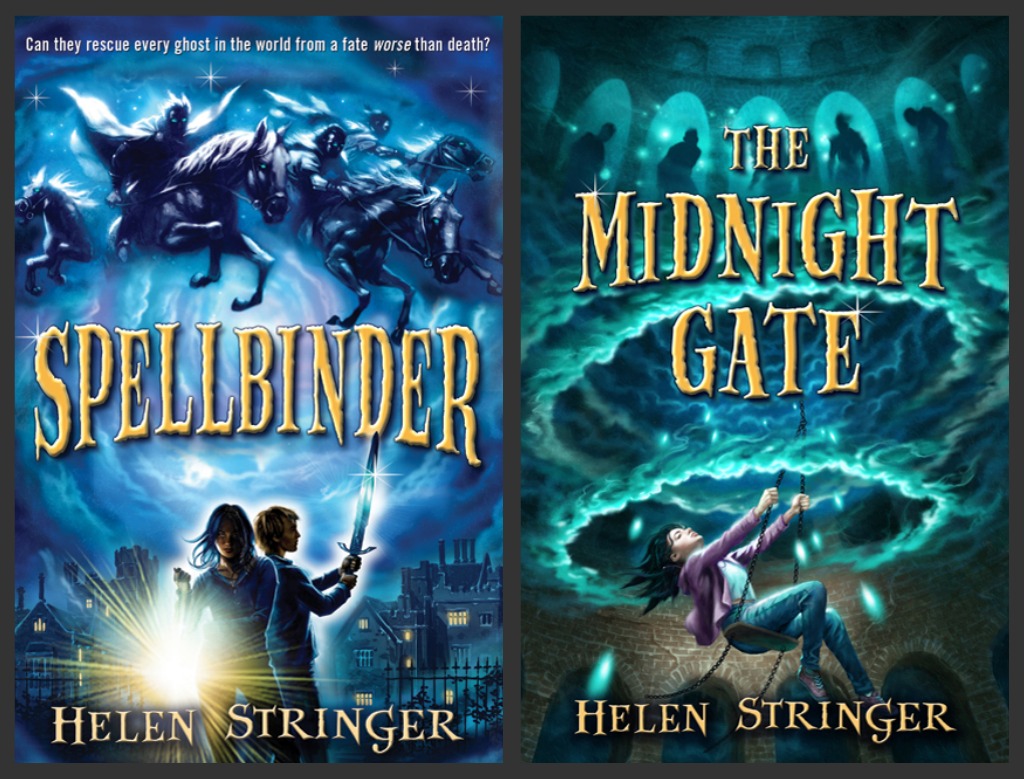
Thanks to Barbara and the folks at Blueslip Media, I have this wonderful opportunity to participate in a Blog Tour Giveaway featuring Helen Stringer and her books Spellbinder and The Midnight Gate. Click here to read my review of Spellbinder.

There is a bit of a twist here. My 10 year old niece, Jackie, loved Spellbinder and she created the questions for the interview. We were thrilled to find out that Helen answered all of our questions.  Hope you enjoy the questions and answers as much as we enjoyed thinking up the questions.

So does Belladonna have a crush on Steve or are they just friends?
No, Belladonna doesn’t have a crush on Steve, he’s a bit too annoying for that at the moment. As to being friends, the only time she ever really talks to him is when it’s something to do with the Dark Spaces. The rest of the time he spends with his other friends talking about football and making trouble.

Has there been any other Spellbinders, and if so how many?
Yes, there have been other Spellbinders. In “Midnight Gate” the Queen of the Abyss tells them a little about the last one and they meet the shade of the last Paladin, whose name is Edmund de Braes. The last time a Spellbinder was needed was in the mid-14th century. In the past, though, Spellbinders were always adults. Belladonna is the first one to be a child, which makes her task much more difficult.

How long did your research take you especially on the Greek language?
The Greek language thing took ages! I don’t speak modern Greek, let alone ancient Greek, and because the Sibyl is from ancient Greece she had to speak the ancient variety. I tried using online translators, but they were all modern Greek. Then I tried to find an ancient Greek dictionary and had the same luck as Belladonna and Steve. I finally found something that translated individual words into ancient Greek and used that, but I’d already discovered that the ancient Greeks had different words or the same thing – for example, the word “door” could be different depending on whether you were opening it or going through it, and whether it was an outside door or an inside door – so I was fairly certain it was wrong. My editor thought so too. She had a Greek friend and asked her, but the friend only knew modern Greek. She then called her local college and managed to speak to someone in the Classics department who knew ancient Greek and gave us the correct translation. Phew! Funnily enough, no one has ever asked if the ancient Sumerian is right, although it really is actual ancient Sumerian, or as close as I can get it using a massive lexicon I found online!

What made you decide to write a ghost story?
I’ve always liked ghost stories and cemeteries. When I was about 12 my family and I went to Scotland on vacation. We stayed in a cottage in a tiny village that had a wonderful old graveyard. The gravestones were huge and had all sorts of details about the person’s life. Many of them had carvings of skulls and crossbones on them, as well as carvings of hourglasses. If the hourglass was lying on its side, it meant that the person had died young – before their time. A lot of the stones went back to the 1600s and were fascinating and sad. On some you could see that entire families had died within days of each other and you knew that some awful disease must have swept through the village. It’s hard not to think about ghosts in places like that, and to wonder if people hang around for a while after they die, and what they might make of our modern world if they do.

Who is your favorite character in the book? (Jackie's response "That's kind of hard. I liked all the characters.")
I’m with Jackie on this one! I like Belladonna because she’s so shy and quiet, yet really brave and smart. Steve is just so much fun to write – he gets to say all those things that you wish you’d said but couldn’t think of at the time. He’s also the kind of kid that everyone thinks they understand because they take him at face value, but he’s so much more than that and only needs the opportunity to be challenged and prove it. I also love Elsie. The Edwardian period was one of great confidence and she embodies that with her gung-ho, can-do spirit. She’s the exact opposite of Belladonna and can be really annoying, but her heart is in the right place. As to the other characters, I’d have to say that I like the Leader of the Wild Hunt and the Queen of the Abyss. They are both mysterious and dark and it isn’t entirely clear whose side they are on.


Why does Belladonna's aunt seem so scared of the Hunt?
She’s not scared. If she was scared, she wouldn’t have gone chasing after them. She has met them before. She knows they are dangerous but there is something that she is hiding. In “Midnight Gate” Belladonna asks the Leader if he has seen Aunt Deirdre and it is clear that he knows who she is too, though he says he hasn’t seen her.

In the book, The Hunt seemed nice to Belladonna but can they be harmful to others? 
The Wild Hunt are very dangerous. They ride the night and can scoop up anyone they want and force them to join the Hunt and ride with them forever. The Wild Hunt are well-known in the mythology of several northern European countries. In Germany they are known as Odin’s Hunt and in France as Arthur’s Hunt. Their legend even crossed the Atlantic and can be seen in songs such as “Ghost Riders in the Sky.” Whatever they are called, the story is the same, a band of mysterious riders that appears out of the night sky to punish the wicked and occasionally even the good. I always liked the idea of these immortal riders who should be avoided at all costs. The Leader has taken a liking to Belladonna, but that doesn’t necessarily mean that he is any less dangerous.

How come people didn't know the truth about Lady Mary?
It’s not at all unusual for history to forget certain details about people and events. This is even more common when the people and events are only of local importance. And, of course, ghosts are good for business. What old house doesn’t claim to have at least one? The story of Lady Mary and her demise is based on a story that the guides at the real-life Speke Hall in Liverpool tell, but although the lady’s husband did gamble away their fortune there isn’t really any evidence that she killed herself and her baby as a result. (And the windows in Speke Hall really are far too small!)
Speke Hall

Now here are some questions for the main characters:

To Belladonna: What did you like most about our adventure?
Gosh, I don’t know. Finding my mum and dad, I suppose. But…well, it was exciting to be able to do something and not be ordinary. I’d always wanted to be ordinary before, of course, and dreaded someone finding out that I could see ghosts – though they’d say that I thought I could see them and then everyone would laugh and…well, it didn’t bear thinking about, really. It was better once Steve could see them, too. The thing with the Words was really scary at first, but it felt really great to stand my ground and send the Kere back to the Dark Spaces. It’s going to be weird having to go back to school and pretend nothing happened!

To Steve: Has your ruler turned into anything else other than arrows and swords?
Yes! The thing is totally brill! It’s been a shield (twice), a blow-gun and a quarterstaff. I’d only seen a quarterstaff in that Daffy Duck cartoon (the Robin Hood one), but it was great. At first we (that’s me and Belladonna) thought it would only work on the Other Side, but it turns out that I can use it in the real world if there are supernatural creatures about, which is good because otherwise Belladonna would be toast by now.

To Elsie: Did you learn anything else (besides the information about the Night Ravens and the Dog) from Ashe's helper?
Not really. The chap was dashed cagey about things. No idea why he picked me, either. I suppose it could have been because I was at the school, but there are a couple of ghosts of teachers flitting about there, too, and you’d have thought he’d pick them. Mind you, now that I think about it, the ghostly teachers are a rather drippy duo. One’s an old art teacher who spends all her time fretting about the quality of everyone’s work and weeping at the windows. The other was a cook in the kitchens and all she does is follow the canteen staff around yelling that they’re doing it all wrong. I’m not sure that either of them would be much use in a crisis, and my grandfather was at Roarke’s Drift, as I said, so I’ve got proper brave soldier’s blood running through my veins. Anyway, I haven’t had such a ripping good time since my dad’s friend took me up in his flying machine!

Thanks Helen for stopping by Kid Lit Frenzy and answering all these questions.  Jackie and I wish you the best of luck with The Midnight Gate and we will post our review after we stop fighting over who gets to read it first. :-)

Spellbinder series giveaway!
Three lucky winners will receive one copy each of THE MIDNIGHT GATE and SPELLBINDER along with some bookmarks!

1. To enter, send an e-mail to SpellbinderSeries@gmail.com.
2. In the body of the e-mail, include your name, mailing address, and e-mail address (if you're under 13, submit a parent's name and e-mail address).
3. One entry per person and prizes will only be shipped to US or Canadian addresses.
4. Entries must be received by midnight (PDT) on 6/17/11. Winners will be selected in a random drawing on 6/18/11 and notified via email.

For excerpts, games, links, and more, visit Helen's website at: http://www.helenstringer.net/
Read Helen's blog: http://helenstringer.net/blog/

To follow her on twitter: @hcstringer

To find her on Facebook:  https://www.facebook.com/profile.php?id=1553125309

Tomorrow's stop will be Mr. Ripley's Enchanted Books at http://mrripleysenchantedbooks.blogspot.com/.